It happens a lot. Luckily, I wasn't in love with the title of my book in the first place. In fact, I'm sort of excited to have some help in renaming my book.
Janie Hannagan: Dream Catcher ... catch you later.
So, now what to name it? This is the tough part. When I first wrote it (for "it" is what we are calling it, now) I had huge troubles coming up with a title. So now what? It remains to be seen, but I imagine "Dream" will be in there somewhere. My editor and I joked about calling it "Angsty Teen Dreamer." But now I need to get serious and think of something. Agent and editor and editor's assistant are all thinking too.

HELLO READERS! My blog has moved. Get the latest news about my New
York Times bestselling UNWANTEDS series, WAKE trilogy, and more at http://lisamcmann.wordpress.com/
Wednesday, February 21, 2007


Wednesday, February 07, 2007
Keeping track
If you haven't found it yet, I started keeping track of things folks are saying about Janie Hannagan: Dream Catcher. If you are so bored that you'll read anything, feel free to take a peek.
Friday, February 02, 2007
Woo Hoo!

"Janie Hannagan: Dream Catcher," a book for teens and up, will hit bookstores in spring of 2008, with its sequel in autumn '08. Published by Simon Pulse.
What's it about?
For 17 year-old Janie Hannagan, getting sucked into other people's dreams is growing tiresome. Especially the falling dreams. The naked but nobody notices dreams. And the sex-crazed teenager dreams. Janie's seen enough fantasy booty to last her half a lifetime.
But then there are the nightmares that leave her blind and paralyzed in fear, even after the dreams are over. Those are the worst. Because one day, someone's going to notice her freefalling to the floor after somebody's study hall naptime nightmare, or collapsing outside a resident's room at the nursing home where she works. Or her worst fear: careening headlong into a tree if she ever drives past *that* house again.
She can't tell anybody about it. They'd never believe her. And she can't do anything to stop it. Until she gets to know Cabel Strumheller, a secretive, pothead flunkie turned pretty-boy. And he accidentally falls into a dream with her on the senior high bus trip to Stratford.
It's his own dream.
And it's a dream he'd rather no one knows about.
Especially Janie Hannagan.
I am thrilled to be a part of Simon & Schuster (Simon Pulse).
And did I mention I love my agent? Because I do.
Tuesday, January 30, 2007
I met an online writer friend
in person for the first time, today. Whee!
It was a fun lunch at The Cheesecake Factory, and then we had to check out B&N to find our fellow writer friends' books.
And I made a new bookstore friend. I hope he works there forever -- he was really smart about the books, knew where everything was, had terrific suggestions. *sigh*
It's nice to find a bookstore worker who actually knows a lot about the books. I wish he worked on commission.
It was a fun lunch at The Cheesecake Factory, and then we had to check out B&N to find our fellow writer friends' books.
And I made a new bookstore friend. I hope he works there forever -- he was really smart about the books, knew where everything was, had terrific suggestions. *sigh*
It's nice to find a bookstore worker who actually knows a lot about the books. I wish he worked on commission.
Wednesday, January 24, 2007
Since my brain is fried,
and I can't pull together a coherent blog post of my own, I bring you a spot-on post from author Holly Kennedy.
Just so that you know why I forget to call you back...for six months. It's not you, it's me.
xo
lisa
P.S. Weather in the Phoenix valley: warming up to 60, finally! Monday we had snow on the mountains again, and ice (read: ICE!!) on the car windshield. You could sell an ice scraper here for a hundred bucks. Thank goo'ness we still had one in the car from when we drove here from Michigan.
Just so that you know why I forget to call you back...for six months. It's not you, it's me.
xo
lisa
P.S. Weather in the Phoenix valley: warming up to 60, finally! Monday we had snow on the mountains again, and ice (read: ICE!!) on the car windshield. You could sell an ice scraper here for a hundred bucks. Thank goo'ness we still had one in the car from when we drove here from Michigan.
Sunday, January 21, 2007
Slang and stuff
WEATHER in the Phoenix Valley: Forty degrees and raining at 2pm. This is insane.
On to the topic of the day. When writing historical fiction, it's a bonus when you can find slang terms. For the first historical I wrote, it was harder because the characters spoke German and lived in England, slowly learning English, and man, that was nuts trying to accurately nail the process, while still writing the entire book in English.
On my second historical, which I'm just starting (yeah, we had a few paranormals in between), life is easier for two reasons. One, I grew up there and know the local dialect with Dutch influence, subtle as it may be (oh, knock it off). Two, a simple Google search brings up websites with slang of the 1920s...it's the berries (aka bee's knees or cat's pajamas)! Though getting used to the word "Bimbo" being used as a compliment (A tough guy) is a little difficult. Insert the word "Bimbo" into a book without proper context could have your readers scratching their heads.
"Bum's rush" today has shades of a sexual nature. In 1925, it meant to get kicked out of an establishment.
"Butt me" sounds, um.... but it was a common phrase referring to lighting up a cigarette, and a "Dick" was, of course, a private investigator.
If you write anything other than present day fiction, a great place to check your slang words is an etymology dictionary. I used it to check the word fink. Did that word exist in 1930? If so, how was it used?
But, as one wise commenter mentioned in the previous post, technology has come a long way in the past 20 years, and the language has changed along with it.
So writers, don't be a pill. Get on the trolley, or you'll be all wet.
On to the topic of the day. When writing historical fiction, it's a bonus when you can find slang terms. For the first historical I wrote, it was harder because the characters spoke German and lived in England, slowly learning English, and man, that was nuts trying to accurately nail the process, while still writing the entire book in English.
On my second historical, which I'm just starting (yeah, we had a few paranormals in between), life is easier for two reasons. One, I grew up there and know the local dialect with Dutch influence, subtle as it may be (oh, knock it off). Two, a simple Google search brings up websites with slang of the 1920s...it's the berries (aka bee's knees or cat's pajamas)! Though getting used to the word "Bimbo" being used as a compliment (A tough guy) is a little difficult. Insert the word "Bimbo" into a book without proper context could have your readers scratching their heads.
"Bum's rush" today has shades of a sexual nature. In 1925, it meant to get kicked out of an establishment.
"Butt me" sounds, um.... but it was a common phrase referring to lighting up a cigarette, and a "Dick" was, of course, a private investigator.
If you write anything other than present day fiction, a great place to check your slang words is an etymology dictionary. I used it to check the word fink. Did that word exist in 1930? If so, how was it used?
But, as one wise commenter mentioned in the previous post, technology has come a long way in the past 20 years, and the language has changed along with it.
So writers, don't be a pill. Get on the trolley, or you'll be all wet.
Friday, January 19, 2007
Researching is FUN
You may disagree, but I think researching is a fascinating adventure.
I'm working on a new novel that takes place in 1930, in the town of my birth. The setting is one I know well -- not because it exists anymore (well, the land is still there), but because I've spent so many hours researching it that I feel like I know it well -- I can picture the buildings, the landscape, the views... yes, the view hasn't changed much in 80 years. And I've been to the site many times.
I'm so excited about this story. Sometimes there's nothing more exciting than real life in a small town in 1930. I'll tell you more as I make some progress.
Meanwhile, I'm reading a history of the 1920s, so I have a very good understanding of the political, social, and economic environment leading up to my story.
Next time: Fun slang words from the 20s and 30s. Some of them might surprise you.
Lisa
I'm working on a new novel that takes place in 1930, in the town of my birth. The setting is one I know well -- not because it exists anymore (well, the land is still there), but because I've spent so many hours researching it that I feel like I know it well -- I can picture the buildings, the landscape, the views... yes, the view hasn't changed much in 80 years. And I've been to the site many times.
I'm so excited about this story. Sometimes there's nothing more exciting than real life in a small town in 1930. I'll tell you more as I make some progress.
Meanwhile, I'm reading a history of the 1920s, so I have a very good understanding of the political, social, and economic environment leading up to my story.
Next time: Fun slang words from the 20s and 30s. Some of them might surprise you.
Lisa
Oooh, Snap
It's been cold here in the desert. Temperatures in the 20s at night have caused people's water pipes to burst and damaged citrus crops (not to mention my two 20-foot tall ficus trees).
So while you East coasters have been lounging in the January heat wave, we've witnessed a cold snap like we haven't seen in years around the Phoenix valley (so they tell me, anyway). Now's your chance to point and laugh. I mean, like, my swimming pool temp is like totally down to 46 degrees.
So while you East coasters have been lounging in the January heat wave, we've witnessed a cold snap like we haven't seen in years around the Phoenix valley (so they tell me, anyway). Now's your chance to point and laugh. I mean, like, my swimming pool temp is like totally down to 46 degrees.
Wednesday, January 10, 2007
Once...
"Once On This Island" is a musical, set in Jamaica.
My daughter just landed a small part in the Actor's Youth Theater production of this.(squeee!) After having a blast with The Three Musketeers last fall, she thinks this one sounds equally fun, maybe even more so. Rehearsals start Saturday.
Performances in early March.
Tickets: $10 for adults and...um...less than that for kids 10 and under.
My daughter just landed a small part in the Actor's Youth Theater production of this.(squeee!) After having a blast with The Three Musketeers last fall, she thinks this one sounds equally fun, maybe even more so. Rehearsals start Saturday.
Performances in early March.
Tickets: $10 for adults and...um...less than that for kids 10 and under.
Tuesday, January 02, 2007
Beaker apparently wasn't an option
| You Are the Swedish Chef |
 "Bork! Bork! Bork!" Your happy and energetic - with borderline manic tendencies. No one really gets you. And frankly, you don't even get you. But, you sure can whip up a great chocolate mousse |
So, hordes of minionses...
where are you? I'm waiting. *tap tap tap*
I know, you're taking down your plastic trees and Menorot*. I'll be here when you're done.
*edited for proper spelling, hat-tip to Sasha
I know, you're taking down your plastic trees and Menorot*. I'll be here when you're done.
*edited for proper spelling, hat-tip to Sasha
Friday, December 22, 2006
Scarce
It's been a while since my last post. I've been working on my MySpace page. There's a link to it over in that side bar ---------->
Happy holidays to all!
Happy holidays to all!
Tuesday, December 05, 2006
Crossover Books
This post is sort of a continuation from last week's.
If there had been a section called Young Adult back when "To Kill A Mockingbird" was first published, according to today's rules it would belong there. I've read more than one literary agent's guidelines that state something like, "If the protagonist is a child or teen, the book is for children."
Well, what if the protagonist is a hobbit...or even a rabbit? When I ran a children's bookstore, we kept a copy or two of "Watership Down" on the shelf. I can't recall selling a single copy of it. The general bookstore across the street from my store carried it too -- in their fiction section. They didn't carry books for children.
But what about this year's "The Book Thief?" It was marketed originally in Australia as a book for adults, even though the protag is eleven. Here, it's called a young adult book, but I've seen it in both children's and adult's sections of bookstores. This book is a successful crossover book - it appeals to an audience of many ages.
Harry Potter -- another obvious success in the crossover department. And Stephenie Meyer's "Twilight" was a surprise crossover. Adults love Edward just as much as teenage girls.
Because I write for teens, I read a LOT of middle grade and young adult books, both new releases and some of the old favorites I read as a teenager. Just finished Judy Blume's "Deenie" the other day...ah, the memories. There are many, many young adult books that I think adults would love. Pick up just about any Newbery Medal or Honor book and you'll find yourself engrossed (I said 'just about'! There are a few that make me shake my head and go 'what were they thinking').
I don't really like compartments, but I can work with them. I'm not sure why the industry has turned in this direction, but for a need for organization - everything in its own defined space. Or maybe the intent was to show kids, "Here -- this is for you. A section, a space, something to which you can claim ownership, in hopes that it will make you want to read more." Did this all begin when R.I.F. began? I have no idea. I never really spent much time thinking about it before.
I wish, though, that calling something YA or MG doesn't somehow 'alienate' adult readers, or cause adults to decide that YA books are for kids, not for grown-ups. Because the adults are really missing out on some terrific stuff!
I'm hoping to see a larger, growing trend of 'crossover' books. Books with child or teen protags that adults will read, even if they have to go to the YA section to find them. I'd guess most bookstores will double-shelf the crossover books, with a few in YA and a few in whatever special adult section it belongs.
Your comments are encouraged.
If there had been a section called Young Adult back when "To Kill A Mockingbird" was first published, according to today's rules it would belong there. I've read more than one literary agent's guidelines that state something like, "If the protagonist is a child or teen, the book is for children."
Well, what if the protagonist is a hobbit...or even a rabbit? When I ran a children's bookstore, we kept a copy or two of "Watership Down" on the shelf. I can't recall selling a single copy of it. The general bookstore across the street from my store carried it too -- in their fiction section. They didn't carry books for children.
But what about this year's "The Book Thief?" It was marketed originally in Australia as a book for adults, even though the protag is eleven. Here, it's called a young adult book, but I've seen it in both children's and adult's sections of bookstores. This book is a successful crossover book - it appeals to an audience of many ages.
Harry Potter -- another obvious success in the crossover department. And Stephenie Meyer's "Twilight" was a surprise crossover. Adults love Edward just as much as teenage girls.
Because I write for teens, I read a LOT of middle grade and young adult books, both new releases and some of the old favorites I read as a teenager. Just finished Judy Blume's "Deenie" the other day...ah, the memories. There are many, many young adult books that I think adults would love. Pick up just about any Newbery Medal or Honor book and you'll find yourself engrossed (I said 'just about'! There are a few that make me shake my head and go 'what were they thinking').
I don't really like compartments, but I can work with them. I'm not sure why the industry has turned in this direction, but for a need for organization - everything in its own defined space. Or maybe the intent was to show kids, "Here -- this is for you. A section, a space, something to which you can claim ownership, in hopes that it will make you want to read more." Did this all begin when R.I.F. began? I have no idea. I never really spent much time thinking about it before.
I wish, though, that calling something YA or MG doesn't somehow 'alienate' adult readers, or cause adults to decide that YA books are for kids, not for grown-ups. Because the adults are really missing out on some terrific stuff!
I'm hoping to see a larger, growing trend of 'crossover' books. Books with child or teen protags that adults will read, even if they have to go to the YA section to find them. I'd guess most bookstores will double-shelf the crossover books, with a few in YA and a few in whatever special adult section it belongs.
Your comments are encouraged.
Wednesday, November 29, 2006
Commercial break
Brought to you by future writers of America.
Post your favorite, or write one of your own in the comments.
Post your favorite, or write one of your own in the comments.
Friday, November 24, 2006
Confusion about kids' books
I've noticed some speculation and muttering lately on these here Internets about categories for kids' books. I thought I'd throw my two pennies into the ring.
When I was a kid, I don't think the categories YA (young adult) or MG (middle grade) existed. There were generally two sizes of books in what was called the Intermediate section of the library. The trade size, which is the larger of the two, indicated (to me, anyway) books for ages 8-12 or so: Beverly Cleary, Eleanor Estes, and the Tales of a 4th Grade Nothing books by Blume. The smaller sized books, called mass market, were in spinner racks. These were for the 12-and-ups. Books like the Sweet Valley High series. SE Hinton. Robert Cormier. More mature works by Judy Blume. There were sub-categories for Fantasy, Science Fiction, Mystery, and Non-fiction.
That was it.
Many kids in high school were assigned books to read such as Huck Finn and To Kill A Mockingbird. These books were found in the Classics section, and included both adult and children's classics. Also, many high schoolers were reading books from the adult section.
Ten years ago, I managed a children's bookstore. We had Picture Books, Early Readers (short, easy chapter books), Intermediate (ages 7-12), and YA (ages 11-14 or so), as well as the usual sub-categories. We determined the correct placement in the store not only by size (mass market vs. trade) but also by content. Some books overlapped.
Today, there are many more categories. That can be a good thing, but it can also make it harder to find the specific book you're looking for in a bookstore or library. Intermediate became Middle Grade, and now there's Tweens as well (ages 10-12).
Also, the Young Adult category has grown fantastically over the past decade or so. It's also gotten edgier. Typical young adult books are considered suitable for ages 10 or 12 to 15 or so, depending on content and the child's reading/comprehension level. You'll find elements including romance (crushes and dating), dysfunction, social/racial/ethnic issues, some abuse (physical and emotional), and sometimes tragedy including death in contemporary YA (for whatever reason, death in historical middle grade appears acceptable, but I don't see a lot of death in the 7-10 year old range of books when the characters are living in current times -- Though Bridge to Terabithia comes to mind).
YA has expanded in age as well, to include more mature themes. Drugs, sex (with some detail, but generally not terribly explicit), moderate amounts of profanity, emotional illness and and teen problems such as anorexia, sexual abuse, teen pregnancy, suicide, murder (as opposed to accidental death)...everything you might find in an adult book. This category is sometimes referred to as Mature YA, Upper YA, or Teen Lit.
So if this upper YA category is similar to adult books, why does it exist? I'm not positive, but unlike 20 years ago, it seems that if the main character of a book is under the age of 20, the book is considered Teen Lit by default.
I invite you to share your opinion -- my post here is my own personal opinion which relies somewhat on memories from 10-30 years ago. I could be waaaaay wrong on this. But I think I'm closer to reality than some.
More on Teen Lit in the next post.
When I was a kid, I don't think the categories YA (young adult) or MG (middle grade) existed. There were generally two sizes of books in what was called the Intermediate section of the library. The trade size, which is the larger of the two, indicated (to me, anyway) books for ages 8-12 or so: Beverly Cleary, Eleanor Estes, and the Tales of a 4th Grade Nothing books by Blume. The smaller sized books, called mass market, were in spinner racks. These were for the 12-and-ups. Books like the Sweet Valley High series. SE Hinton. Robert Cormier. More mature works by Judy Blume. There were sub-categories for Fantasy, Science Fiction, Mystery, and Non-fiction.
That was it.
Many kids in high school were assigned books to read such as Huck Finn and To Kill A Mockingbird. These books were found in the Classics section, and included both adult and children's classics. Also, many high schoolers were reading books from the adult section.
Ten years ago, I managed a children's bookstore. We had Picture Books, Early Readers (short, easy chapter books), Intermediate (ages 7-12), and YA (ages 11-14 or so), as well as the usual sub-categories. We determined the correct placement in the store not only by size (mass market vs. trade) but also by content. Some books overlapped.
Today, there are many more categories. That can be a good thing, but it can also make it harder to find the specific book you're looking for in a bookstore or library. Intermediate became Middle Grade, and now there's Tweens as well (ages 10-12).
Also, the Young Adult category has grown fantastically over the past decade or so. It's also gotten edgier. Typical young adult books are considered suitable for ages 10 or 12 to 15 or so, depending on content and the child's reading/comprehension level. You'll find elements including romance (crushes and dating), dysfunction, social/racial/ethnic issues, some abuse (physical and emotional), and sometimes tragedy including death in contemporary YA (for whatever reason, death in historical middle grade appears acceptable, but I don't see a lot of death in the 7-10 year old range of books when the characters are living in current times -- Though Bridge to Terabithia comes to mind).
YA has expanded in age as well, to include more mature themes. Drugs, sex (with some detail, but generally not terribly explicit), moderate amounts of profanity, emotional illness and and teen problems such as anorexia, sexual abuse, teen pregnancy, suicide, murder (as opposed to accidental death)...everything you might find in an adult book. This category is sometimes referred to as Mature YA, Upper YA, or Teen Lit.
So if this upper YA category is similar to adult books, why does it exist? I'm not positive, but unlike 20 years ago, it seems that if the main character of a book is under the age of 20, the book is considered Teen Lit by default.
I invite you to share your opinion -- my post here is my own personal opinion which relies somewhat on memories from 10-30 years ago. I could be waaaaay wrong on this. But I think I'm closer to reality than some.
More on Teen Lit in the next post.
Tuesday, November 14, 2006
Another Great YA
Newbery Honor winner Lizzie Bright and the Buckminster Boy is an historical novel that takes place in Maine in the early 1900s. Filled with racial tensions and religious disharmony, author Gary Schmidt transports the reader to the shores of the real town of Phippsburg, gives us a variety of tremendously developed characters, and shows us the coast through his gorgeous description. I feel like I've seen a whale in real life.
(well I have, actually, but this is different - it's the description, man!)
And I can't tell you about this book without feeling rather proud that Gary Schmidt was one of my favorite college professors back in Michigan in the late 80s. Prof. Schmidt taught (and still teaches) kiddie lit, among other English/lit classes. Good job, sir! I give you an A.
(well I have, actually, but this is different - it's the description, man!)
And I can't tell you about this book without feeling rather proud that Gary Schmidt was one of my favorite college professors back in Michigan in the late 80s. Prof. Schmidt taught (and still teaches) kiddie lit, among other English/lit classes. Good job, sir! I give you an A.
Sunday, November 12, 2006

Saturday, November 11, 2006
Aw, myahn! I haven't lost my midwest accent...
Though carbonated drinks are not 'pop' anymore. Definitely 'soda'.
My ten year old daughter's accent has changed the most in the past two years. Which is funny, because Phoenix is it's own little melting pot, and there's really not a 'southwest' accent, as far as I can tell.
My ten year old daughter's accent has changed the most in the past two years. Which is funny, because Phoenix is it's own little melting pot, and there's really not a 'southwest' accent, as far as I can tell.
| What American accent do you have? Your Result: The Inland North You may think you speak "Standard English straight out of the dictionary" but when you step away from the Great Lakes you get asked annoying questions like "Are you from Wisconsin?" or "Are you from Chicago?" Chances are you call carbonated drinks "pop." | |
| The Northeast | |
| Philadelphia | |
| The Midland | |
| The South | |
| North Central | |
| Boston | |
| The West | |
| What American accent do you have? Take More Quizzes | |
Tuesday, November 07, 2006
A new addition

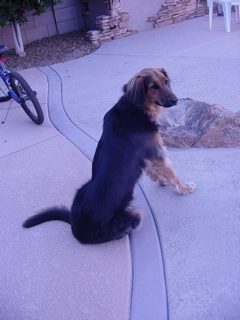
After searching high and low for just the right dog for our family, I think we have a winner.
Jessie is a 3.5 year-old saluki mix. Emphasis on the 'mix'. Though no one seems to know what the mix part is. She's black and tan, shorter and stockier than the saluki in the photo at the link, and has a thick coat. When she stands to look at something, she reminds me of a small golden retriever with a collie-face.
We were very picky in our selection. We didn't want a puppy. We wanted a medium-sized dog who is housebroken, doesn't bark, doesn't chew on the furniture, doesn't need a huge amount of exercise, and doesn't shed. We got everything we wanted except the 'doesn't shed' part. Yay.
Wednesday, November 01, 2006
Subscribe to:
Posts (Atom)